Adaptive-Depth Temporal Representation Memory
for Multi-Camera 3D Detection
1 Google Research
* Corresponding author: moshekimhi@google.com

Not every driving frame needs a full encoder.
Remember the scene. Update what changes. Adapt the depth.
EvoMem3D combines a persistent appearance memory with partial features from the current frame. A lightweight controller selects how deep to encode each frame, while current camera geometry keeps 3D predictions aligned.
DETR3D · EVA-02-L · 6 cameras · 320 × 800 · NVIDIA A100
Different scenes. Different depths.
Twenty-second front-camera rollouts with predicted 3D boxes and the encoder depth executed on every frame. Drag the colored timelines, or use the arrow keys, to explore each decision. Compare with the baseline below →
Low-speed cruising
Shallow updates with periodic full refreshes.
Sharp turn
Shallow prefixes before the turn; deeper evidence during rotation.
Dense scene
Checkpoint behavior through a busy intersection.
Fast motion
Checkpoint behavior under faster ego motion.
Complete nuScenes validation scenes, played at the original 2 Hz sampling rate. Every box is a detector prediction. The cruising and turning cards initially show an illustrative schedule: inference is rerun at the chosen exits, with normal memory-refresh safeguards. Switch to Learned policy to see the checkpoint’s unedited routing. Depth labels are verified against encoder execution hooks. “Depth” means encoder blocks, not object distance.
Exit naming and rollout provenance
In this trained implementation, the internal L8/L12/L16 routes use inclusive zero-based stop indices, executing 9/13/17 blocks; Full executes all 24. Video labels report these actual counts. The original trained behavior is preserved. Media provenance records source scenes, checkpoint hashes, and the actual per-frame decisions. Illustrative schedules are demonstrations, not learned-policy evaluation results.
The same scene, side by side.
Compare the full-depth baseline with EvoMem3D’s unedited learned policy. Both detectors see exactly the same camera frames, with the same box-rendering threshold and a shared playback clock.
Full-depth baseline
Full · 24 blocksEvoMem3D
Learned encoder depthEach pair covers one complete 20-second nuScenes scene. Playback is matched at the source 2 Hz sampling rate for visual comparison; wall-clock inference results are reported in the Results section. The comparison uses the learned policy throughout. Matched-scene provenance.
Reuse appearance.
Keep geometry current.
Large vision transformers make repeated full-depth image encoding a dominant cost in multi-camera 3D detection, even though adjacent driving frames share much of their visual content.
EvoMem3D caches the most recent full-depth appearance representation as a read-only anchor and combines it with policy-selected partial features from the current frame. A lightweight controller chooses the encoder exit before image processing, using online temporal and ego-motion signals.
Appearance memory is separated from geometric alignment: current-frame camera calibration defines decoder geometry at every timestamp, and a motion-conditioned positional adapter accounts for movement since the anchor. The same feature-interface approach supports both DETR3D and StreamPETR.
A little current evidence.
A lot of useful memory.
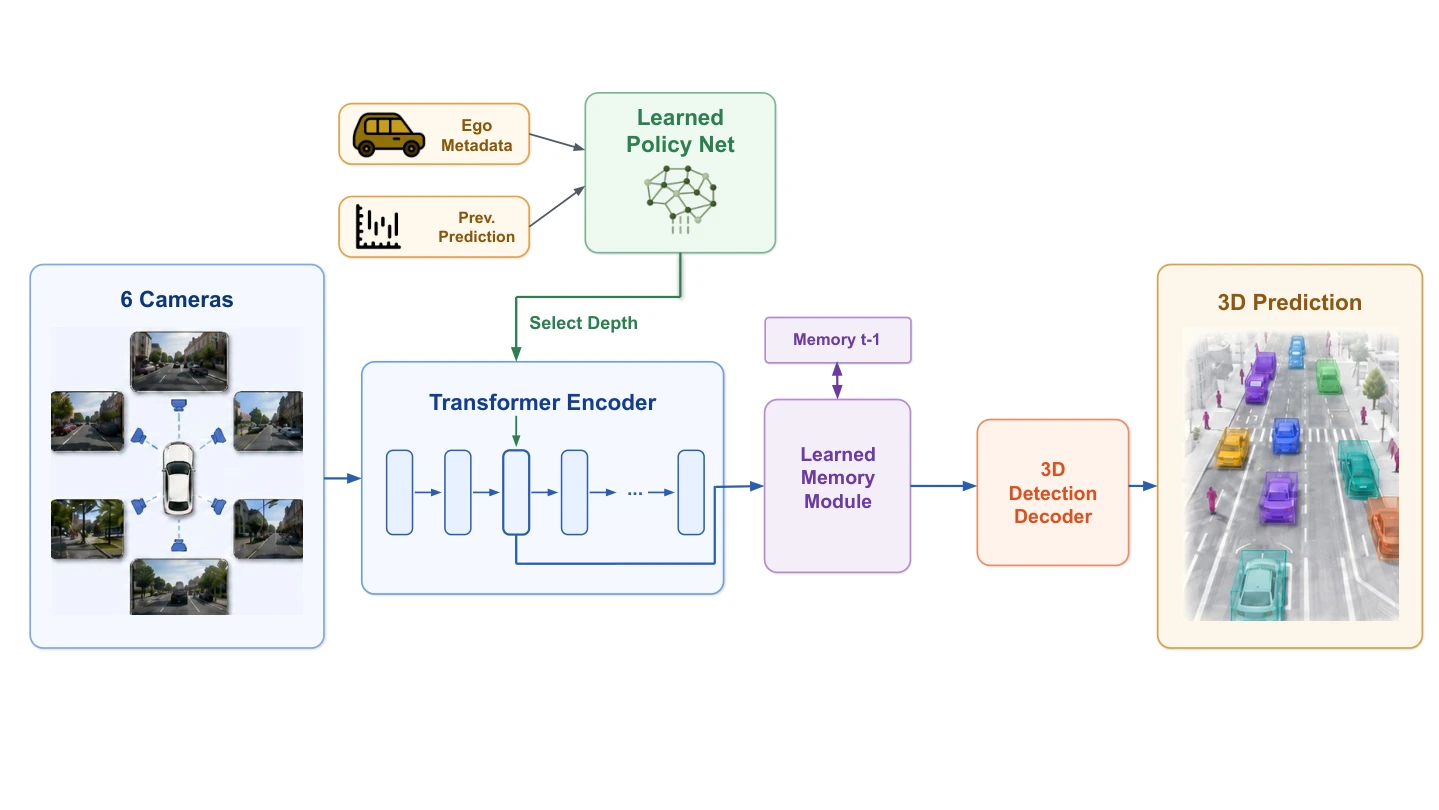
Choose the computation
A pre-encoding policy selects Early, Intermediate, Late, or Full using information available online.
Update from an anchor
Full encoding refreshes the appearance anchor. Partial encodings provide current evidence for a lightweight correction.
Align to the present
Recomputed camera geometry and motion-conditioned positional alignment support current-frame 3D predictions.
Less encoding. Strong detection.
The temporal memory interface works across two detector families. Speedups are measured against each detector’s dense baseline in its reported environment.
| Detector | NDS ↑ | mAP ↑ | Latency ↓ | Speedup ↑ |
|---|---|---|---|---|
| DETR3D · dense baseline | 60.81 | 51.20 | 364.4 ms | 1.00× |
| DETR3D + EvoMem3D | 61.50 | 52.76 | 168.7 ms | 2.16× |
| StreamPETR · dense baseline | 61.18 | 52.10 | 350.6 ms | 1.00× |
| StreamPETR + EvoMem3D | 61.36 | 52.55 | 182.3 ms | 1.92× |
End-to-end wall-clock latency on a single NVIDIA A100. Values are from the current manuscript; accuracy measurements are single runs.
Citation
If you find this work useful, please cite our paper.
@misc{kimhi2026evomem3dadaptivedepthtemporalrepresentation,
      title={EvoMem3D: Adaptive-Depth Temporal Representation Memory for Multi-Camera 3D Detection},
      author={Moshe Kimhi and Idan Kligvasser and Yotam Intrator and Regev Cohen and Ehud Rivlin},
      year={2026},
      eprint={2611.20241},
      archivePrefix={arXiv},
      primaryClass={cs.CV},
      url={https://arxiv.org/abs/2611.20241},
}